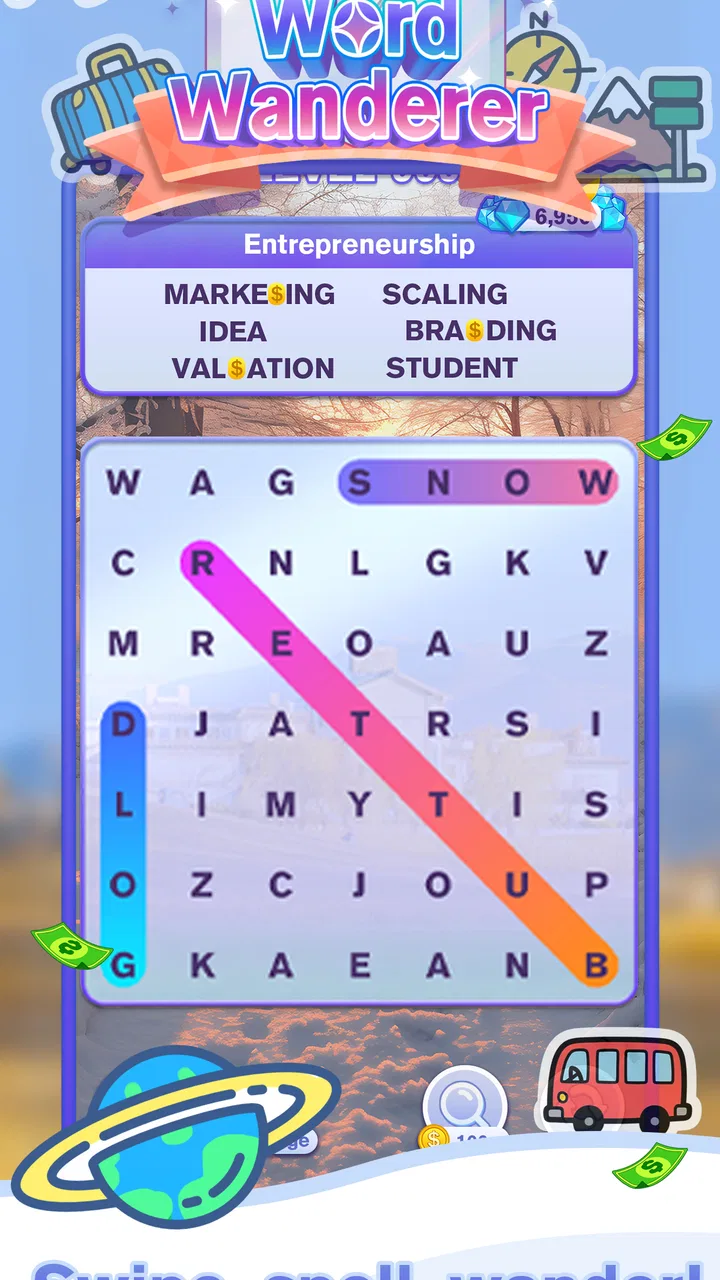
Word Wanderer - win real cash
- 4.8
- Rating
- 50.00K
- Installs
- Free
- Price

 Analysis by App-foxy
I approached Word Wanderer as a casual word game first, but its promise of earning diamonds and cashing out through PayPal naturally changes how I judge it. It is not only about whether the word challenges are enjoyable; the important questions are whether the screen is comfortable to read, whether the controls feel manageable, and whether the reward path is clear enough to use without frustration. After spending time with it, I see a simple game that may suit people who like short vocabulary sessions, while also requiring sensible expectations about the cash angle.
The game comes from hindustanfood and is available free of charge for Everyone. It belongs firmly to the word-game category, so its main appeal is the familiar pleasure of spotting letters, forming words, and trying to improve your result. Its store presence is still relatively modest, with more than 50 thousand installs, but the response shown by players is strong: an average of 4.8 from roughly 2.8 thousand ratings and 299 written reviews. The current release is version 1.4 and requires Android 9 or later.
How Word Wanderer feels to use in different situations
I look at this section through the moments when a quick word puzzle is genuinely useful, rather than treating every session as a chance to chase a reward. A quiet wait and a crowded commute can call for different pacing, and noticing that difference helps me decide when the swipe-based play feels relaxing and when it is better to put the phone away.
You May Also Like

 Blood Strike: 2.5 Anniversary
Blood Strike’s Loadouts Turn Every Drop Into a Tactical Gamble
A close look at Blood Strike’s custom loadouts: how fast access to signature weapons reshapes its battle royale rhythm, rewards preparation, and narrows the gap between fights.

 Pandora - Music & Podcasts
Pandora’s Music Is Easy to Start, but Harder to Recover
Pandora’s strength is its low-effort path from a seed to a station. Its weak spot is how much confidence it asks you to place in connection, setup, and quiet recovery.

 8 Ball Pool
 Is Built on Rivalries, Rematches, and Routine
A close look at the rivalries, rematches, shared routines, and unanswered safety questions that turn a quick pool match into a persistent mobile community.

 Samsung Music
’s Quiet Strength Is Playing What You Already Own
Its reach comes less from spectacle than from dependable access to a personal library. That simplicity is both the app’s strongest retention engine and its ceiling.

 AccuWeather: Weather Radar
AccuWeather Review: A Quick, Clear Forecast for Everyday Decisions
For everyday plans, the best forecast is the one you can understand quickly. AccuWeather makes rain timing, radar, and local conditions easy to act on, with a few trade-offs.

 Hill Climb Racing
Why Hill Climb Racing Still Turns Crashes Into One More Run
A tiny car, a bumpy hill and one more upgrade: Hill Climb Racing keeps resurfacing because its simple chaos makes every near-miss feel personal.
More From Our News Desk
View All News


Readability and navigation come before the rewards
The first thing I look for in a word game is whether I can understand the board without having to study the screen. Word puzzles depend on quick visual recognition. If letters, buttons, counters, or reward indicators compete for attention, the game becomes tiring even when the underlying puzzle is good. In this case, I would treat the clarity of the play area as more important than the promise of diamonds. A player should be able to tell what can be swiped, what has already been selected, and what action comes next without guessing.
That matters especially because the game combines two different activities: solving words and managing the reward journey. The puzzle itself is likely to attract people who want a light mental break, while the diamond and PayPal elements give the session a more goal-driven feel. I recommend learning the basic word interaction before thinking about the cash-out route. That simple order helps separate the entertainment from the incentive and makes it easier to notice whether the game is actually enjoyable on its own.
For me, the most practical way to approach a session is to begin slowly rather than swipe immediately at maximum speed. In word games, rushing can make a player overlook short words, misread a letter, or drag across the wrong path. A deliberate first pass also gives people with less experience a chance to understand the board. Once the interaction becomes familiar, faster play can feel natural, but speed should not be treated as the only measure of success.
The navigation around rewards deserves the same attention as the puzzle screen. Anyone interested in using PayPal should read each instruction carefully, especially the wording around diamonds, eligibility, and the steps required to request a payout. I would not assume that collecting an in-game currency automatically means an immediate transfer. The sensible habit is to treat the reward section as a separate process: check what the game asks you to do, confirm the account details before submitting anything, and keep expectations realistic.
This is also where the free model can affect the experience. A free word game is easy to try, but the player may feel more pressure when every round appears connected to a financial outcome. I prefer to decide in advance whether I am playing for the puzzle or pursuing the reward. If the cash objective becomes the only reason to continue, even a small amount of friction can make the whole session feel like work instead of play.
Motor and sensory considerations during word play
Swiping sounds simple, but it is still a physical gesture that not every player finds equally comfortable. Someone using one hand on a crowded bus, playing with a tired wrist, or dealing with reduced precision may find long or diagonal movements less reliable than a slower touch interaction. I would hold the phone securely, use the finger that gives the best control, and avoid trying to complete a word with an unnecessarily fast gesture.
People with tremors or limited fine-motor control may need to decide quickly whether the swipe mechanic is comfortable enough for regular use. A game built around tracing letters can be less forgiving than a word game where players tap individual tiles or type answers. That does not make this title unsuitable for everyone with a motor limitation, but it does mean the first few sessions should be treated as a practical test. If missed gestures happen repeatedly, a keyboard-based alternative may be kinder.
Visual comfort is another important consideration. Word games ask for repeated focus on small symbols, and extended sessions can become uncomfortable for players with low vision, visual fatigue, or sensitivity to busy screens. I would use the phone at a comfortable distance, increase the device’s system text size where possible, and avoid playing in glare. Those adjustments may improve general phone use, although they cannot guarantee that every game element will scale equally well.
Players who are color-sensitive should pay attention to whether selected letters, available actions, and completed results remain distinguishable without relying only on color. A good word interface should communicate state through more than a tint change, such as position, text, shape, or motion. If a player cannot tell whether a swipe registered, the problem is not vocabulary skill; it is feedback. That distinction is useful when deciding whether to keep trying or choose a more accessible puzzle format.
Sensory load can also come from the pace of a round. Some people enjoy quick decisions and visual movement, while others need a quiet, predictable presentation. I would recommend playing in a calm setting first, with notifications silenced, so it is easier to judge the game itself. If the experience feels comfortable there but becomes difficult in a noisy or bright environment, the issue may be situational rather than a permanent limitation.
Situational access: where the game fits well
Word Wanderer makes the most sense as a short-session companion. I can imagine opening it while waiting for an appointment, taking a brief break from household tasks, or relaxing before bed. A word puzzle is a useful choice in those moments because it gives the mind something active to do without requiring the long commitment of a story game. The reward system may encourage another round, but I would still set a stopping point so the session does not stretch simply because diamonds are visible.
A realistic everyday example would be a commuter with a few spare minutes between connections. That player can begin with a small goal: solve a handful of boards, observe how accurately swipes register, and leave without feeling that the session was wasted. If the phone is being used one-handed, the commuter should keep the device stable and avoid playing while walking. The game may be convenient in a waiting situation, but attention still belongs on surroundings when moving through public spaces.
It can also work for people who enjoy vocabulary practice in an informal way. I would not describe it as a structured language-learning tool, because a word game and a lesson serve different purposes. Still, looking for possible words can encourage pattern recognition and recall. Players who want definitions, pronunciation guidance, grammar explanations, or a planned curriculum would be better served by a dedicated learning app alongside this game.
The Everyone content rating makes it approachable for a broad audience, including families deciding whether a child can try it. Even so, the cash theme changes the conversation for younger players. I would explain that diamonds and a PayPal cash-out claim should not be treated like guaranteed pocket money, and I would involve a parent or guardian before any account or payment step. The age label describes content suitability; it does not turn the reward process into a financial product for children.
Older adults who enjoy word puzzles may find the basic concept familiar, but the swipe requirement and small interface elements deserve attention. I would suggest trying it on the largest comfortable phone screen available and checking whether the player can distinguish letters without strain. For someone who prefers crosswords, anagrams, or typed answers, this may be less comfortable than a traditional puzzle app, even if the vocabulary challenge itself is appealing.
What separates it from ordinary word-game alternatives
The obvious difference is the reward framing. Many word games focus on streaks, levels, hints, or personal scores, while this one presents diamonds and a PayPal cash-out path as part of its identity. That can make a routine puzzle feel more purposeful for players who enjoy collecting toward a target. It can also create a trade-off: a conventional word game may feel more relaxed because there is no expectation that play should lead to money.
I would choose this game over a standard word puzzle when I want a lightweight challenge with an additional reward objective and I am comfortable reading the payout instructions carefully. I would choose a traditional crossword or anagram app when I want deeper clues, more control over difficulty, or a purely recreational session. I would choose a typing-based word game when precise swiping is uncomfortable. The best alternative depends less on the cash promise than on how the player likes to interact with words.
There is another subtle trade-off involving motivation. Rewards can help a player return to a game, but they can also make a person tolerate an interface they do not actually enjoy. My advice is to use a two-question test: would I play a few rounds without thinking about cash, and can I understand the reward steps without feeling pressured? If the answer to both is yes, the combination may work well. If either answer is no, a simpler word game is probably the better daily choice.
Remaining barriers and sensible precautions
The largest practical barrier is the gap between an in-game reward and a real-world payment expectation. A player may understand the general idea but still wonder how many diamonds are needed, what conditions apply, how long a request takes, or what account information is required. Before investing substantial time, I would inspect the in-game instructions and decide whether the process feels transparent. I would also avoid entering sensitive information hastily or assuming that a visible balance has the same value as money already received.
Another barrier is that the game’s accessibility may depend heavily on the individual phone and the player’s settings. System-level adjustments such as brightness, magnification, touch sensitivity, and screen-reader preferences can help with general device use, but they do not guarantee that every game control will respond perfectly. Anyone relying on assistive technology should test the core swipe action and reward navigation early, rather than building a routine around a feature that turns out to be difficult to operate.
Language ability can affect the experience too. A player who knows many words in the game’s language may have a clear advantage over someone who is still learning it. That is not necessarily a flaw in a word game, but it means the cash-oriented framing can feel less even across users. If the goal is language improvement, I would pair the game with a dictionary or learning resource instead of expecting puzzle play alone to explain unfamiliar vocabulary.
Attention is a final consideration. Because the game encourages repeated rounds, it may be easy to continue longer than planned, particularly when a player is chasing a target. I recommend using it during intentional breaks rather than during tasks that require concentration. The same advice applies to children and anyone who finds reward loops hard to ignore: agree on a time limit before starting, and regard the payout feature as optional rather than an obligation.
Updates can also change how a game feels. Version 1.4 is the current release, so players should keep an eye on the in-app experience after updating and reread important reward instructions if the interface changes. I would not rely on an old understanding of the cash-out route simply because the puzzle controls look familiar. Separating gameplay habits from payment decisions is a small precaution, but it prevents confusion.
My inclusive verdict
I see Word Wanderer as a focused option for people who already enjoy swipe-based word puzzles and like the idea of working toward diamonds. Its free price lowers the barrier to trying it, the Everyone rating makes the content broadly approachable, and the strong average response suggests that many players find the concept appealing. The developer, hindustanfood, has kept the central idea easy to understand: solve words, collect the in-game reward, and explore the PayPal route.
My recommendation comes with conditions. The game is a good fit if you can read the board comfortably, control swipe gestures without strain, and are happy to treat the cash feature as an extra rather than a promise of dependable income. It is less suitable if you need large, highly adjustable controls, prefer typed answers, want a serious language course, or dislike checking reward requirements before committing time.
The most inclusive way to use it is to judge the puzzle and the payout path separately. First, see whether the letters are readable and the gestures are manageable in your usual environment. Then review the reward instructions with the same care you would give any account-related action. That approach leaves room for the game to be enjoyable without allowing the cash angle to hide practical barriers.
In my experience, the title is worth a cautious try for casual word-game fans, especially those who want a short activity with a collection goal. I would recommend starting with brief sessions, avoiding rushed swipes, and stopping if the interface becomes tiring or the reward process feels unclear. For players who value comfort, predictability, and accessibility above incentives, a conventional word game may remain the better choice. For everyone else, Word Wanderer offers an interesting blend of vocabulary play and rewards, provided its financial appeal stays in the background rather than becoming the sole reason to play.
FAQs for Word Wanderer - win real cash
01What is Word Wanderer - win real cash?
Word Wanderer - win real cash is a word puzzle game that combines vocabulary challenges with the possibility of earning cash rewards. Players typically form words, complete levels, and compete through game-based challenges. The app is designed for casual play, but reward availability, scoring rules, and competition formats may vary depending on your location, the current promotion, and the version installed.
02Can I really win real money with Word Wanderer?
The game may offer opportunities to win cash prizes, but earnings are not guaranteed. Rewards usually depend on successfully completing challenges, ranking in competitions, meeting eligibility requirements, and following the app’s rules. Before playing for rewards, carefully review the payment terms, minimum withdrawal threshold, prize conditions, and any restrictions that may apply to your country or account.
03Is Word Wanderer - win real cash free to download and play?
Word Wanderer may be available as a free download, allowing users to access its basic word puzzles without paying an upfront purchase price. However, free games can include advertisements, optional in-app purchases, or other monetization features. Check the Google Play Store or Apple App Store listing before installing to confirm current pricing, supported devices, subscriptions, and whether any paid features are required.
04How do withdrawals and cash rewards work in Word Wanderer?
Withdrawal methods and eligibility can differ according to the app version, region, and available reward program. You may need to reach a minimum balance, verify your identity, provide payment details, or complete additional requirements before requesting a payout. Processing times are not always immediate, so read the official payment policy carefully and avoid assuming that every in-game reward can be converted into cash.
05Is Word Wanderer safe for my device and personal information?
Download Word Wanderer only through an official app store and check the developer name, recent reviews, requested permissions, and privacy policy before installation. As with any rewards-based game, be cautious when sharing payment or identity information, and never provide unnecessary credentials. Keep your operating system updated, avoid unofficial APK files, and review the app’s data-collection practices before creating an account.
Pros
- Quick word puzzles are easy to play during short breaks.
- Simple controls make the game accessible for most players.
- Cash prizes can add extra motivation for competitive users.
- New challenges may help keep repeat sessions interesting.
- The lightweight format should suit casual mobile gaming.
Cons
- Cash rewards may depend on eligibility
- location
- and available contests.
- Winning is not guaranteed
- even for skilled or frequent players.
- Ads or promotional offers may interrupt the gameplay experience.
- Some features or prize withdrawals may require account verification.
- In-app purchases could encourage spending without guaranteeing returns.

Word Wanderer - win real cash
Gallery